Section 1: The Experience
What happened? (Experience details and context)
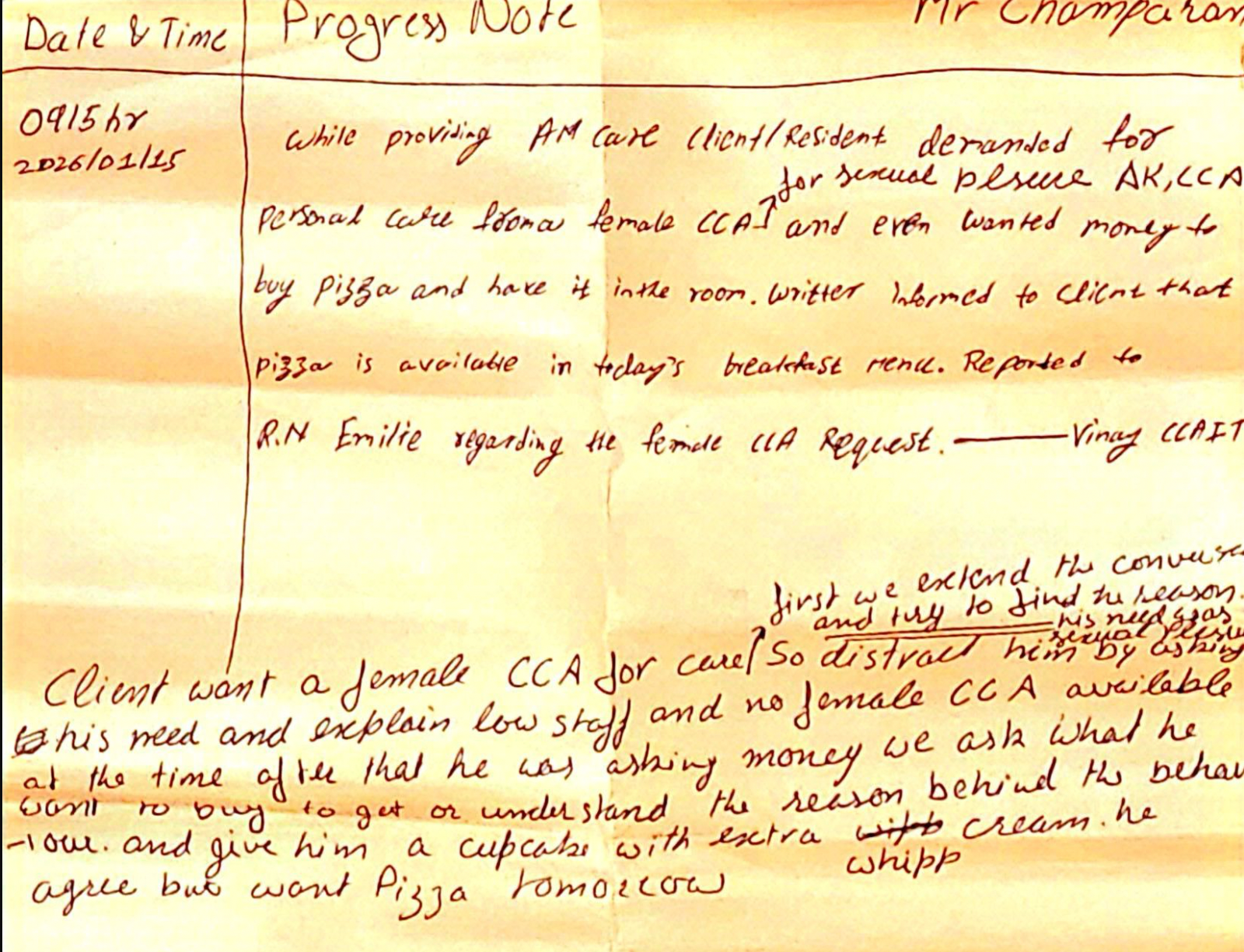
We practiced a scenario involving a client, Mr. Champaran, who made inappropriate requests. Initially, he requested a female CCA for personal care. Upon investigation, we realized the behavior was driven by a desire for sexual pleasure. We managed this by explaining staff availability and using distraction techniques. Later, he asked for money for pizza; we redirected him by offering a cupcake and promised pizza would arrive later, which successfully de-escalated his behavior.
When and where did the experience occur?
This experience occurred at our college lab.
Who was involved?
CCAs: Ajay Kumar, Ashish, and Viney
Resident: Parth (acting as Mr. Champaran)
RN/Instructor: Emily
Resident: Parth (acting as Mr. Champaran)
RN/Instructor: Emily
Section 2: Reflection on Feelings and Actions
How did you feel during the experience?
Initially, the request felt like a simple preference. Discovering the actual sexual motivation was shocking. It made me realize that these situations will happen in our future careers. We must handle them to protect the resident’s dignity while keeping ourselves safe by applying everything we learned in the course.
How did this experience impact others?
This scenario showed that checking a Care Plan is vital. If a healthcare team documents these patterns, it helps ensure the safety of female CCAs and helps the team make the best clinical decisions for the resident.
What did you do well? What could be improved?
Well: Our communication was strong. We successfully used distraction and read the client’s facial expressions to find the "real reason" behind his requests.
Improvement: Having this hands-on experience in a lab setting helps me feel more "pro-active." I am now better prepared to stay calm and professional in real-world scenarios.
Improvement: Having this hands-on experience in a lab setting helps me feel more "pro-active." I am now better prepared to stay calm and professional in real-world scenarios.
Section 3: Analysis
What principles or theories are relevant?
The lab highlighted the CCA Scope of Practice, understanding Behavioral Cues, Effective Communication, and Distraction. We focused on how to tackle favors that are inappropriate or outside our professional boundaries.
How do these relate to the situation?
We applied the scope of practice by refusing requests that violated boundaries (money/sexualized care). We communicated with the client to find the "unmet need" and resolved the tension by distracting him with a different activity and a snack.
What key lessons have you learned for your growth?
I learned that disease can affect a resident's thinking and judgment. Even if they ask for inappropriate things, we cannot show anger. Dealing with this calmly is essential for our growth as professional CCAs.
Section 4: Action Plan
What specific steps will you take?
I will work on my distraction skills to become more creative in how I redirect clients. This will help me handle complex behaviors more effectively in the field.
How will you implement this across the CCA Program?
During my placements, I will practice showing more empathy while managing my own emotions. I will also use a feedback process with my peers to see my performance from different points of view.
What resources or support might you need?
I will seek support from experienced CCAs, my instructors, and online resources to keep improving my behavioral management skills.
Progress Note (Documentation)
Date: Jan 15, 2026 @ 0915hr | Resident: Mr. Champaran
"Resident requested female staff for personal care, expressing inappropriate sexual motivation. Staff explained current staff availability and utilized distraction techniques. Resident subsequently requested money for food. Staff redirected resident with a snack (cupcake). Resident accepted snack and was successfully redirected to other conversation. Behavior de-escalated. Care plan updated to reflect behavioral cues."
Signature: Ajay Kumar, CCA Student